



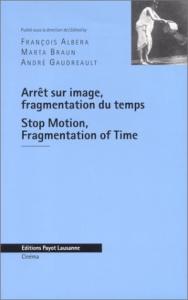
Arrêt sur image, fragmentation du temps
(book in French)
Edited by François Albera, Marta Braun and André Gaudreault


 (0 vote)
Average rating:
| 0 | rating |  = We can do without = We can do without |
| 0 | rating |  = Good book = Good book |
| 0 | rating |  = Excellent book = Excellent book |
| 0 | rating |  = Unique / a reference = Unique / a reference |
Your rating: -
Book Presentation:
L'histoire du cinéma ou de l'image animée ne se construit pas dans l'enchaînement des inventions et des expérimentations qui se succèdent en quelques décennies, elle se déploie au plan d'une histoire culturelle du regard qui appartient à la longue durée. "Le cinéma" s'y inscrit dans sa dimension anthropologique. Le XIXe siècle voit un formidable bouleversement des habitus visuels des sociétés industrielles, lié non seulement aux perfectionnements ou découvertes technologiques dans le domaine de l'optique, mais aussi aux découvertes astronomiques, aux redéfinitions des catégories de l'espace, du temps, de la vitesse. Adviennent, en particulier, les catégories de discontinuité et de fragmentation qui découlent de l'irruption de prothèses techniques et de dispositifs. La place de l'"observateur", du sujet, en est transformée et, avec elle, l'édifice même du savoir. Arrêt sur image, fragmentation du temps s'interroge sur l'avènement du cinématographe dans ce contexte de la fin du XIXe siècle en tenant compte de cette généalogie scientifique, technique, spectaculaire ou culturelle dont il procède et qu'il transforme. Mais l'originalité des recherches proposées ici tient non seulement dans la mise à jour de nouveaux matériaux, l'exploitation d'une documentation inédite - touchant en particulier Muybridge, Anchütz ou Lumière -, mais encore à la démarche des auteurs. Le point de vue s'est voulu ici "régressif" : "remontant" de la cinématographie à la chronophotographie via la "kinétographie", soit des années 1890 aux années 1880. On assiste aujourd'hui à une réorganisation des données historiques, techniques, imaginaires liées à ce qu'on a coutume d'appeler "pré-cinéma" et, simultanément à une réactivation des problématiques et des procédures des machines et jouets optiques, tant dans l'approche des films telle que l'autorisent les nouvelles technologies de diffusion-réception que dans un certain nombre de pratiques artistiques contemporaines : de Bruce Nauman à Matrix, les problématiques de l'image successive sont rejouées, reformulées. Cette archéologie offre donc un des moyens de saisir ce qui se joue dans notre présent. The history of cinema, or the moving image, is not a product of a series of inventions and experiments confined to a few decades ; it is, rather, a part of a cultural history of the gaze that extends over a much longer period. "Cinéma" is a part of this history in an anthropological sense. There was a tremendous upheaval in visual practices in industrial societies in the nineteenth century, an upheaval that derived not only from technological discoveries or refinements in the realm of optics but also from astronomical discoveries and redefinitions of space, time, and speed. The role of the subject or the "observer," was transformed, and with it the very structures of knowledge. Stop Motion, fragmentation of Time is attentive to the contextual "intermediality" of cinema's late nineteenth century origins- the traditions of the popular performing arts and the scientific and technological framework within which cultural space was ordered. However the originality of this book is not only in the documentation and the new sources that are explored - in particular Muybridge, Anchütz or Lumière -, but also in the aim of the authors. The diachronic view - tracing the Cinématographe back to chronophotography via the kinetoscope, from the 1890s to the 1880s, from Lumière to Marey via Edison - is proclaimed as "regressive". Today we are witnessing a reorganisation of historical data and practices, both technological and artistic, dating from the period the "pioneers" of film history labelled "pre-cinema." Simultaneously, we have become aware of a renewed interest in optical devices and toys, both from the perspectives afforded by new technologies for disseminating and consuming cinema (videos, DVD, the computer), and from the number of contemporary artistic practices whose interest in the apparatus rather than the final product refers us bock to the model of cinema. From Bruce Nauman to The Matrix, the logic of the moving image is engaged and reelaborated. This archeology offers a tool for understanding what is at stake in our time.
> From the same authors:
La Retransmission d'opéras en salle de cinéma (2024)
Dir. Marie-Odile Demay and André Gaudreault
(in French and English)
La fin du cinéma ? (2023)
La résilience d'un média à l'ère du numérique
by André Gaudreault and Philippe Marion
Subject: General
De l’assemblage au montage cinématogra-
phique (2022)
Instauration et standardisation d’une pratique

Eisenstein et le constructivisme russe (2019)
Subject: Director > Sergueï Eisenstein
La Fin du cinéma ? (2019)
Un média en crise à l'ère du numérique
by André Gaudreault and Philippe Marion
Subject: Economy
Le Ciné-œil de la révolution (2018)
écrits sur le cinéma
by Dziga Vertov, François Albera, Antonio Somaini and Irina Tcherneva
Subject: Director > Dziga Vertov
Le Récit cinématogra-
phique (2017)
Films et séries télévisées
by André Gaudreault and François Jost
Subject: Film Analysis
Techniques et technologies du cinéma (2015)
Modalités, usages et pratiques des dispositifs cinématographiques à travers l'histoire
Dir. André Gaudreault and Martin Lefebvre
Subject: Technique > All techniques

Le Film sur l'art (2015)
Entre histoire de l'art et documentaire de création
Dir. Valentine Robert, Laurent Le Forestier and François Albera
Subject: General
Léon Moussinac (2015)
critique et théoricien des arts - Anthologie critique
by Léon Moussinac, Valérie Vignaux and François Albera
Subject: Film Analysis
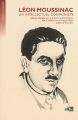
Léon Moussinac (2015)
un intellectuel communiste - volume d'études
Dir. Valérie Vignaux and François Albera
Subject: Film Analysis
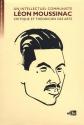
Léon Moussinac (2014)
un intellectuel communiste, critique et théoricien des arts
Dir. Valérie Vignaux and François Albera
Subject: Film Analysis
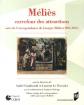
Méliès, carrefour des attractions (2014)
Suivi de Correspondances de Georges Méliès (1905-1937)
Dir. Jacques Malthête, André Gaudreault and Laurent Le Forestier
Subject: Director > Georges Méliès
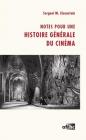
Notes pour une histoire générale du cinéma (2014)
by Sergueï Eisenstein, François Albera and Naoum Kleiman
Subject: Director > Sergueï Eisenstein
La fin du cinéma ? (2013)
Un média en crise à l'ère du numérique
by André Gaudreault and Philippe Marion
Subject: General
Ciné-dispositifs (2011)
spectacles, cinéma, télévision, littérature
Dir. François Albera and Maria Tortajada
Subject: History of Cinema
Alexandre Sokourov (2009)
Dir. François Albera and Michel Estève
Subject: Director > Alexandre Sokourov
Poétique du film (2008)
Textes des formalistes russes sur le cinéma
Dir. François Albera
Subject: Theory
Cinéma et attraction (2008)
Pour une nouvelle histoire du cinématographe, suivi de Les vues cinématographiques
by André Gaudreault and Georges Méliès
Subject: Director > Georges Méliès
Le Cinéma en histoire (2008)
Institution cinématographique, réception filmique et reconstitution historique
Dir. André Gaudreault, Germain Lacasse and Isabelle Raynauld
Subject: History of Cinema

Dictionnaire du cinéma français des années vingt (2002)
Revue 1895 n°33
Dir. François Albera and Jean A. Gili
Subject: Silent Cinema
Cinéma suisse, nouvelles approches (2000)
Histoire, esthétique, critique, thèmes, matériaux
by François Albera and Maria Tortajada
Subject: Countries > Switzerland
Le Cinéma au tournant du siècle (1999)
Cinema at the turn of century
Dir. Claire Dupré la Tour, André Gaudreault and Roberta Pearson
Subject: Silent Cinema
Les Formalistes russes et le cinéma (1996)
poétique du film
Dir. François Albera
Subject: Countries > Russia / USSR
Cinéma sans frontières, 1896-1918, Images Across Borders (1995)
Dir. Roland Cosandey and François Albera
(in French and English)
Subject: Sociology

Picturing Time (1995)
The Work of Etienne-Jules Marey (1830-1904)
by Marta Braun
(in English)
Subject: History of Cinema
Pathé 1900 (1993)
Fragments d'une filmographie analytique du cinéma des premiers temps
Dir. André Gaudreault
Pathé 1900 (1993)
Fragments d'une filmographie analytique du cinéma des premiers temps
Dir. André Gaudreault
Une invention du diable? (1992)
Cinéma des premiers temps et religion
Dir. Roland Cosandey, André Gaudreault and Tom Gunning
Subject: History of Cinema
Eisenstein et le constructivisme russe (1990)
Subject: Director > Sergueï Eisenstein
Le Récit cinématogra-
phique (1990)
Cinéma et récit II
by François Jost and André Gaudreault
Subject: Film Analysis
Une invention du diable? (1990)
Cinéma des premiers temps et religion
Dir. Roland Cosandey, André Gaudreault and Tom Gunning
Subject: History of Cinema
Ce que je vois de mon ciné (1988)
La représentation du regard dans le cinéma des premiers temps
Dir. André Gaudreault
Subject: History of Cinema
Eisenstein, le mouvement de l'art (1986)
by François Albera, Naoum Kleiman and Sergueï Eisenstein
Subject: Director > Sergueï Eisenstein
Cinéma brésilien (1983)
1970-1980, une trajectoire dans le sous-développement
by Paulo Antonio Paranagua, José Carlos Avellar and François Albera
Subject: Countries > South America
See more books in English from the author: François Albera
See more books in English from the author: Marta Braun
See more books in English from the author: Andre Gaudreault
> On a related topic:
Sur les pas de Marey (2004)
Dir. Thierry Lefebvre, Laurent Mannoni and Jacques Malthête
Subject: History of Cinema


Note: A book on a beige background is a book published in a language other than French.
(*) En tant que Partenaire Amazon, je réalise un bénéfice sur les achats remplissant les conditions requises. The buttons « Acheter chez Amazon.fr », « Commander sur Fnac.com » & « Rakuten » are affiliate links. The webmaster of this site receives a small commission when you click the button and purchase a book.These (small) commissions are the only income, livres-cinema.info does not contain any other advertising.
 Back
Back

