



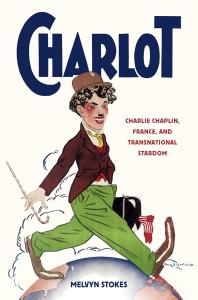
Charlot
Charlie Chaplin, France, and Transnational Stardom (livre en anglais)

Plates-formes :
Librairies :
Livres d'occasion :
(*) Lien affilié - voir note en bas de page


 (0 vote)
Moyenne des votes :
| 0 | vote |  = On peut s'en passer = On peut s'en passer |
| 0 | vote |  = Bon livre = Bon livre |
| 0 | vote |  = Excellent livre = Excellent livre |
| 0 | vote |  = Unique / une référence = Unique / une référence |
Votre vote : -
Description de l'ouvrage :
The first films made by British comedian Charlie Chaplin in California reached France in March 1915. They had an instant appeal for wartime French audiences-- "Charlot," the name under which Chaplin became known in France, quickly became a screen celebrity and a focal point for France's burgeoning film culture. His supporters ranged from members of the working-class through film writers such as Louis Delluc, who wrote the first book on Chaplin as an artist in any language, to members of the French literary avant-garde.
As the "Little Tramp," he seemed to many French intellectuals to embody the spirit of post-World War I society. When he was subjected to criticism from American sources over his private life or political opinions, French intellectuals sprang to his defense. During his acrimonious divorce from Lita Grey in 1927, Surrealists justified his behaviour. And when American reviewers attacked his films Modern Times (1936) and Monsieur Verdoux (1947) for being too left-wing, he was supported by French critics. Modern Times, with its critique of factory conditions, struck a particular chord in France where its arrival coincided with mass factory sit-ins during the "Popular Front" summer of 1936.
Chaplin's next film, The Great Dictator (1940), a satire on fascist rulers, due to the French surrender and German occupation was not screened in France until 1945, when it became the most popular film of the year by far. French critics, writers and politicians continued to support Chaplin when he was persecuted by right-wing Americans in the 1940s and early 50s for sexual scandal and supposed pro-communist leanings. Driven into exile in Europe in 1952, Chaplin's career as a filmmaker began to flag--the films he made outside the United States, A King in New York (1957) and A Countess from Hong Kong (1967), seemed to suggest his decline. But the celebration of his long career that took place at the 25th Cannes Film Festival in 1971 set the stage for the next few years in which Chaplin experienced what he himself described as his “renaissance”.
Through the lens of French admiration, Chaplin emerges not just as a cinematic genius, but as a symbol of resilience, rebellion, and artistic reinvention.
À propos de l'auteur :
Melvyn Stokes is Professor of Film History at University College London. He taught for a year as a Fulbright Fellow at Mount Holyoke College and has been a visiting fellow at Princeton University and the École des Hautes Études en Sciences Sociales in Paris. He is the author of several books on cinema history, including D. W. Griffith's The Birth of a Nation (OUP, 2007), and has edited or coedited a dozen other titles. He is the former President of SERCIA, a France-based organization of film scholars specializing in English-speaking cinema.
Voir le site internet de l'éditeur Oxford University Press
Voir la filmographie complète de Charlie Chaplin sur le site IMDB ...
> Livres ayant un titre identique ou proche :






> Du même auteur :

D.W. Griffith's The Birth of a Nation (2008)
A History of 'The Most Controversial Motion Picture of All Time'
de Melvyn Stokes
(en anglais)
Sujet : Un Film > Naissance d'une nation
Cinéma et histoire (2007)
Cinema and history
Dir. Melvyn Stokes et Gilles Menegaldo
(en français et anglais)
Sujet : Genre > Historique
Voir plus de livres en anglais de l'auteur Melvyn Stokes
> Sur un thème proche :

Silent Traces (2006)
Discovering Early Hollywood Through the Films of Charlie Chaplin
de John Bengston
(en anglais)
Sujet : Réalisateur > Charlie Chaplin

Charlie Chaplin (2010)
De vie en vie
de Michel Puech et Brigitte Labbé
Sujet : Réalisateur > Charlie Chaplin




Nota : Un livre sur fond de couleur beige est un livre édité dans une autre langue que le français.
(*) En tant que Partenaire Amazon, je réalise un bénéfice sur les achats remplissant les conditions requises.
Les boutons « Amazon », « Fnac » & « Lireka » sont des liens affiliés. Le gestionnaire de ce site reçoit une petite commission lorsque vous achetez un livre après avoir cliqué sur le bouton. Ces petites commissions sont les seuls revenus de ce site qui ne contient aucune publicité, aucune insertion (ou mise en avant) payante, aucun cookie de profilage ou de tracking à but commercial.
 Retour
 FNAC (*)
 AMAZON.fr (*)
 LIREKA (*)
 CULTURA
 MOLLAT
 FURET DU NORD
 LES LIBRAIRES
 PLACE DES LIBRAIRES
 MOMOX
MOMOX ABE BOOKS